
More Real than Real
Caricatures in Media

Patterns
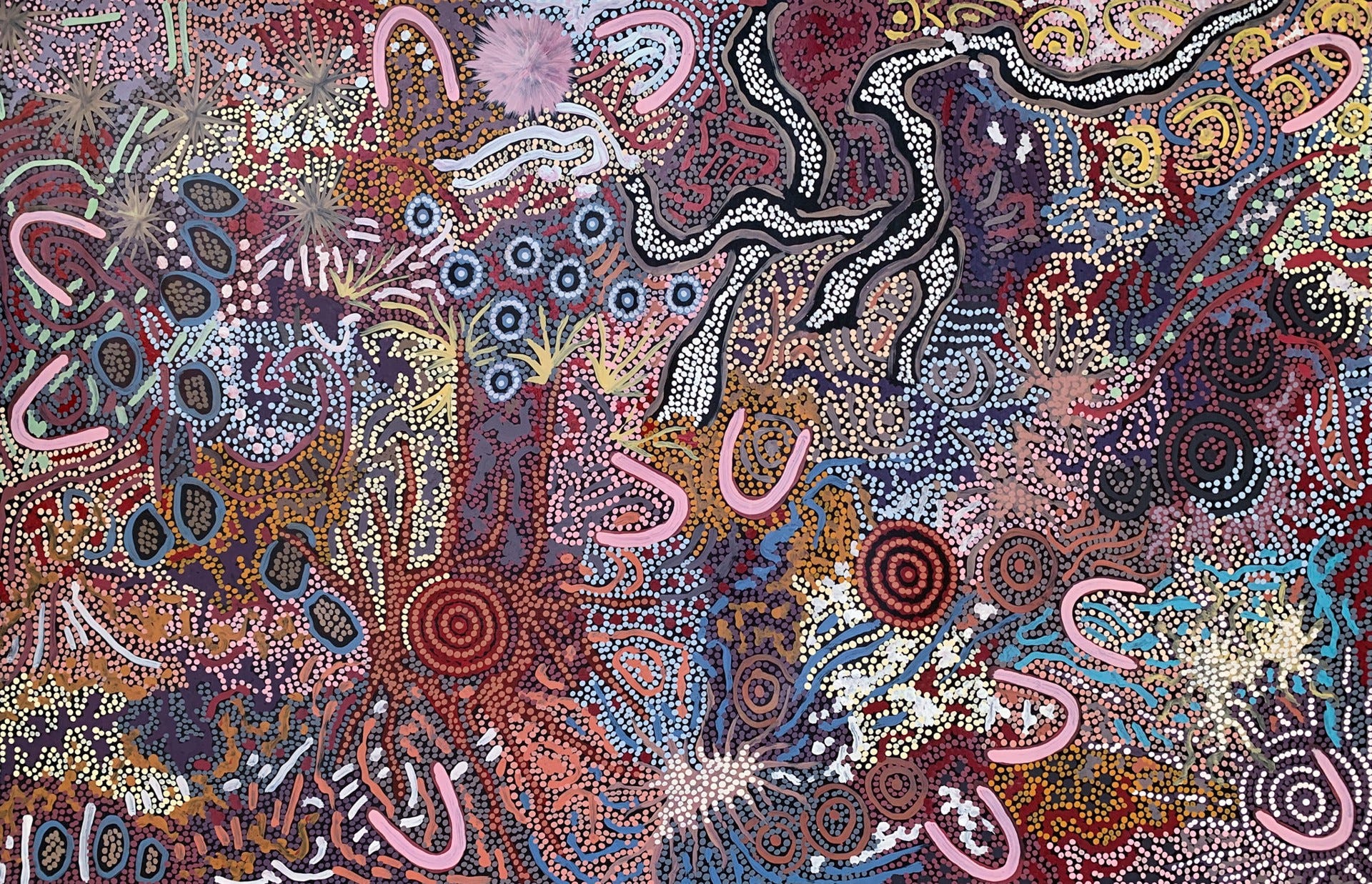
Grandmother’s Country, a series of paintings from the Wentworth Gallery1
Storytelling has an interesting relationship with reality - the material state of the world. For the native Australians, storytelling was an important ritual and spiritual practice, valuable commodities worth more than food and hunting tools. A story could be a map or a moral lesson, but it was more - it was deeply animistic, bridging the ancestral spirits to the present in a mystical way. It contained within it memories of a reality long forgotten - truths more real than the dry, Australian grass that broke underfoot and the red desert sand that sifted through their hands.2
The sense of reality in storytelling has never been something tangible and materialistic. Stories aren’t a copy of reality, but to us they feel very real - and to some more real than reality.
This comes back to perception. Your mind does not see reality, you don’t get pure “video footage” beamed into your head, so to say. Instead, the mind interprets the things your eyes see to give you a picture of reality that is both “more real” and also less accurate to the sensory data itself.
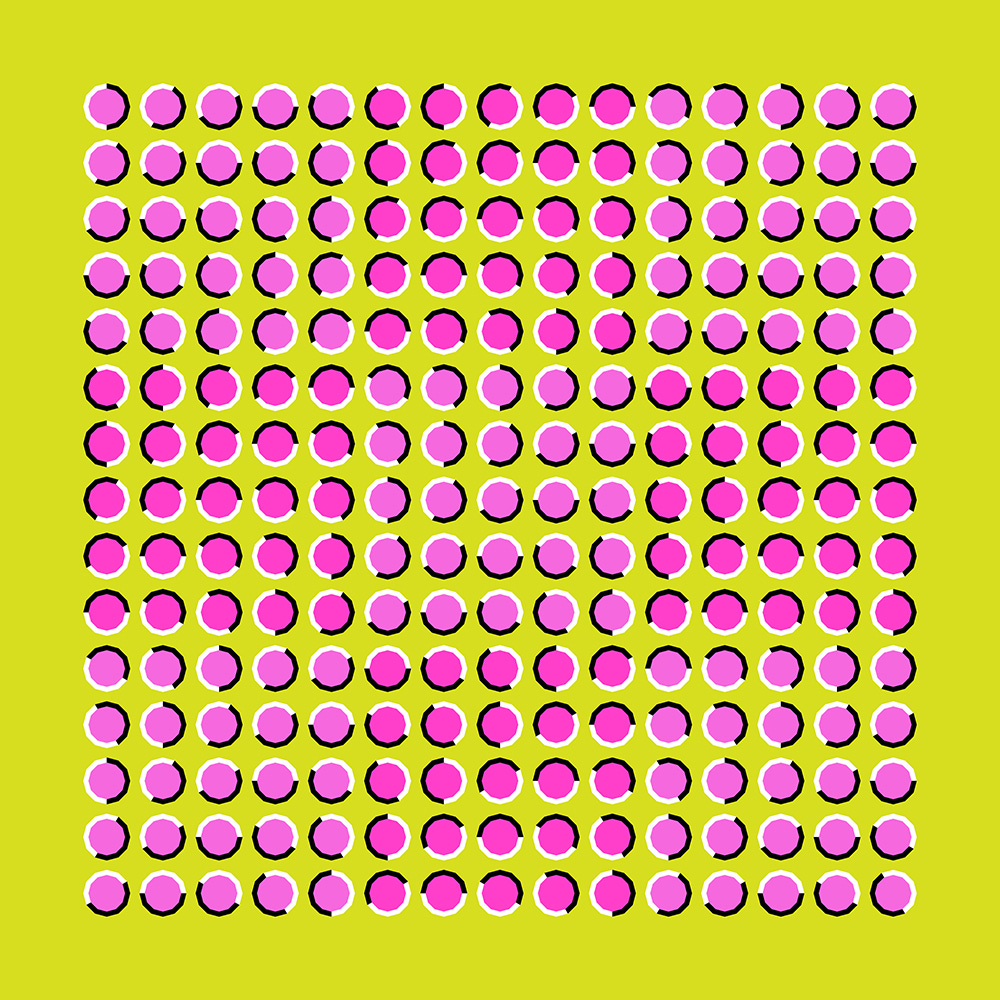
An Optical Illusion from the Queensland Brain Institute3
We are made to see patterns and “truths within truths.” This is what storytelling does, it gives us the “pattern” of a life, an experience, a person, an object.
Consider a television series about an Emergency Response ward - say Grey’s Anatomy - and ask yourself how accurate it is to a real ER. Maybe you say ‘well that’s not trying to be accurate,’ so we can look at something like Scrubs or ER instead and ask whether those are. Many people would say yes, but they’re all wrong in a ‘realistic’ sense. No TV show about ERs have ever shown the long and monotonous experience of doing repetitive nursing work, has shown every action and conversation from the endless checking of monitors to the bathroom breaks and dull snide comments that build up over time between coworkers in that grating, sandpapery way which is too subtle to complain over and yet existentially distressing. Nor do they show the pain of constantly walking the halls of the ward, the bruised heels and the throbbing ache that goes up the foot and into the calf. All of that is boring, but Scrubs is authentic.
This idea of authenticity, telling a story in a way that shows truth, isn’t about portraying things as they physically are but as they really are. It’s secret knowledge, gnostic wisdom about the human experience - hyperintelligible4. And fundamentally, it’s a caricature of reality.
Caricature
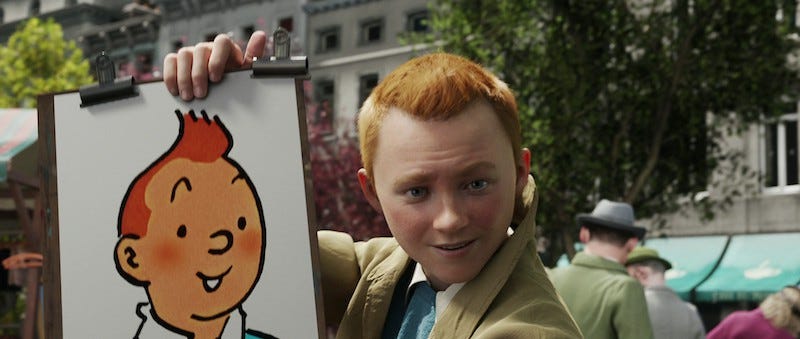
Spielberg’s Adventures of Tintin is trying to ask you “Look! Have I done him justice?” I like to think he did, but ‘realistic Tintin’ certainly feels less iconic.
To comic artist Scott McCloud, a caricature of a person is more than just a simplification. It is that too - by choosing which elements of a person to emphasise in the caricature and which to ignore, one ends up with a simplified, a ‘truer’ representation of the person as they are on some existential level. Tintin’s comic portrait feels friendly, inquisitive, and generic - an everyman - whereas the Spielbergian Tintin looks less clear, confused by the wrinkles of the face and turn of the cheeks, and appears more like a real guy you could meet on the streets of New York.
But deeper than this, McCloud has suggested that the simplified caricature becomes a vessel for the self to identify with. A realistic portrait looks like someone external, but a simple and iconic portrait represents the way you see yourself, or as McCloud puts it:
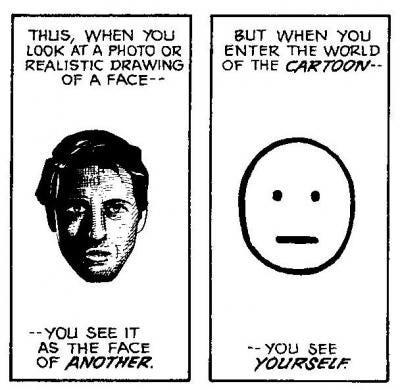
S. McCloud, Understanding Comics, page 36
The secret power of the caricature lies in how people identify with it, they step into the it in a way they simply cannot step into the perspective of a more tangible and real person. The things a caricature experiences are more personal and touching than that of a stranger.
Perhaps this goes some way to explaining the retreat into cartoon we are seeing with modern generations in the NEET5 subcultures. It may be from a lack of socialisation, perhaps a past trauma with community, or an overpowering self obsession. And so we shouldn’t be surprised to see that Japan is the epicentre of this movement inwards - for they are notoriously socially repressed6. We have seen time and time again that cartoon has become a refuge for those who can no longer stand the company (and complexity) of other people.
Digressions aside, this sense of caricaturing reality happens in every medium of art. Even a photograph is a caricature, so to say, for the realities of the photo cannot be touched, tasted, smelt, or heard. We would be hard pressed to say it is a truly realistic portrayal of sight either, as post-processing and image editing are often used to make the photo look ‘better,’ more real and vibrant than reality.
French Impressionism
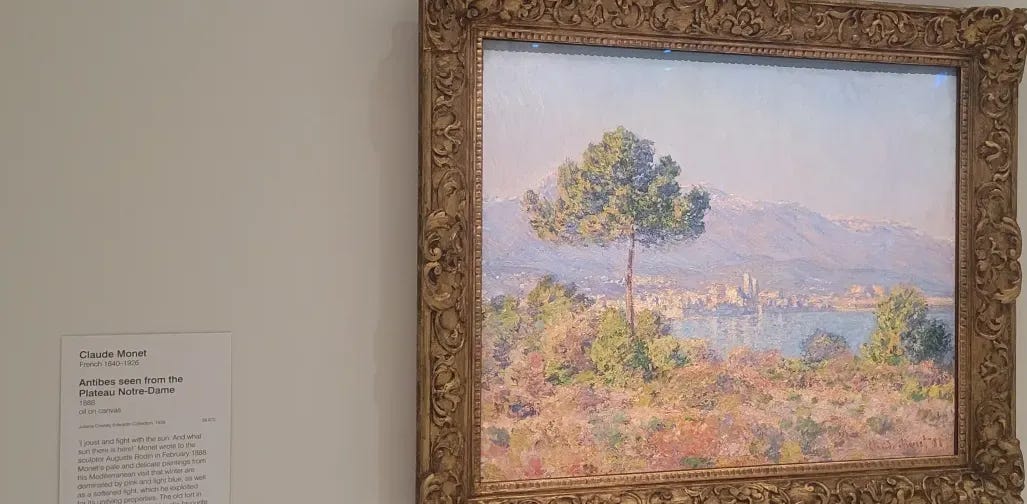
C. Monet (1888) ‘Antibes Seen from the Plateau Notre-Dame’, source: me. Art galleries are neat.
When not advocating for paedophilia, French people do occasionally come up with interesting things. Impressionism is one such thing, an exploration of colour and authentic vision.
French impressionism must be understood as a rebellion from realism. In the 19th century, the western world was caught in the grips of a rabid obsession with it, and in depicting things as they truly were. This was an enlightenment search for absolute truth which sought to surpass the rigid and awkward-looking art of the Medievals, and a heartfelt desire to recapture that Greek artistic perfection so described by Pliny the Elder7 and his Antiquitous contemporaries.
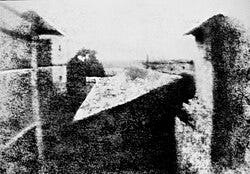
N. Niépce (1826-7) ‘View from the Window at Le Gras’
Though many failed attempts were made, we know that by the 1820s, Nicéphore Niépce had made a rudimentary photographic reproduction of the world outside his window. Yet by the 1830s, the daguerreotype became available for public purchase, and photography was something real which would not go away. The art critic Charles Baudelaire proclaimed photography to be “art’s most mortal enemy” and raged over that “natural and pitifully literal medium of expression for a self-congratulatory, materialist bourgeois class”. Some artists despondently announced that the photograph had killed art entirely. As usual, the full spectrum of reactions ranged from naïve optimism, apathy, and the abovementioned seething rage, but there was no doubt that the very pursuit of realism had come into question as an occupation8.
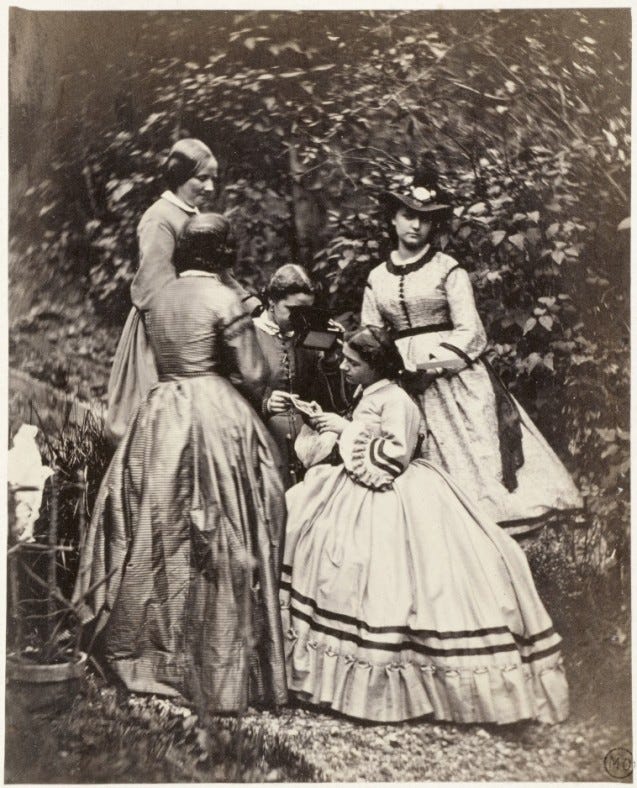
A. Bonnuit (1865) ‘La séance de stéréoscopie.’
By the 1860s, photographs had improved dramatically to the point where representation became clear and dynamic. There was no longer any doubt where the technology was leading.
Though much more than a response to photography, impressionism was, in essence, a way of continuing the pursuit of the “real” in a world of perfect photographic representation that was felt to be lacking some authentic spirit. As the word implies, the movement was about creating a vibrant impression of the subject rather than a perfect representation of it. With large, vague brush strokes of strong and powerful colours, artists were able to portray the subjects they saw in a way that captured the pattern of their minds beyond the simple appearance of the thing. It is hard to see by my photos - or any photos at all for that matter - just how vibrant and alive the paintings of the impressionists were9. They must truly be seen to be believed.
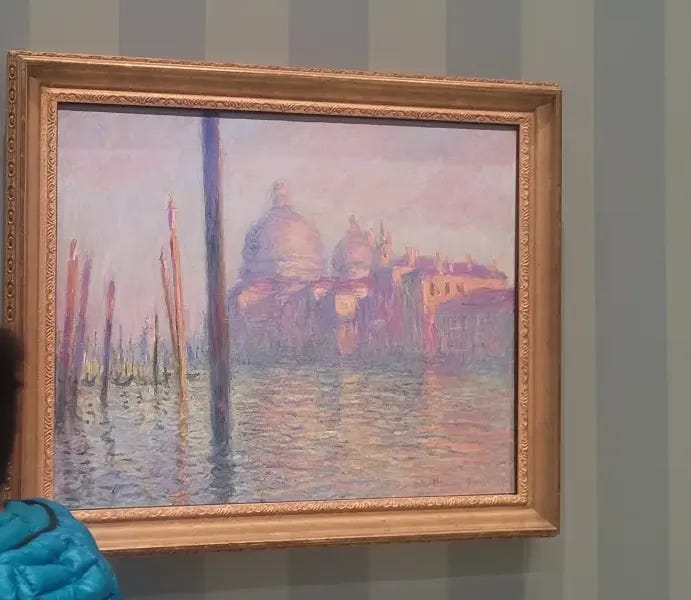
C. Monet (1908) ‘Le Grande Canal.’
Antiquity and Imitation
All cultures began as oral cultures. The telling of stories was not something written, though sometimes illustrated, and instead the focus was on the act of telling or reciting stories. Transmission not just to friends and family, but down through the generations became essential, particularly as the stories gained deep spiritual and experiential weight - such as the victory over Troy was for the Greeks. These kinds of beliefs and ideas are essential for ‘caricaturing’ the world, filtering meaning in order to produce something more intelligible to our pattern-recognising brains than the sheer infinity of reality.
The Iliad is our prime example of a story transmitted orally throughout a whole people, and surviving today as part of the key bedrock of western thought. Storytelling was poetry, poetry was song, and thus the Aoidoi (singers) of Greece became wandering teachers of history, morals, and good society - the Iliad narrative the prime religious authority for the Greeks.
With oral transmission, small details get lost and narratives shift over time. This is not some accidental thing, but the very living nature of storytelling. Every Aoidoi breathed life and vision into the Iliad, and no recital was ever entirely the same. The joy of narrative came in owning for oneself the stories of one’s ancestors, and the idea of a written text would have seemed at first dead and useless. By memorising and being immersed in these stories, there was a deep spiritual connection which held the people of Greece together with one common heart, mythic past and eternal present, a universal heart that could recite:
They shared a splendid funeral feast in Hector’s honour,
Held in the house of Priam, king by will of Zeus.

And so the Trojans buried Hector breaker of horses.
or in their tongue:10
EŨ SUNAGEIRÓMENOI DAÍNUNT᾽ ERIKUDÉA DAĨTA
DṒMASIN EN PRIÁMOIO DIOTREPHÉOS BASILĒ̃OS.

HṐS HOÍ G᾽ AMPHÍEPON TÁPHON HÉKTOROS HIPPODÁMOIO.
The intrusion of mythic Homer into this happy situation and his transcription of the Iliad and Odyssey forever changed the nature of how the Greeks related to their mythos. As a written text it became more rigid - though the flexible nature of the musical performance never changed - and it could the more easily be exported. Thus “Greek education” became a core part of their colonial power projection across the Mediterranean. The Roman conquest served only to send that influence further afield.
And so the hyperreality of narrative evolved. The Iliad’s status as a fixed text meant that it could no longer evolve to suit the whims of culture and society, and this naturally created tensions between the ancestral Greek and his literate descendants. On the flip side, literature allowed for more texts to be transmitted than the common man could memorise. Plato, Aristotle, Pliny, Archimedes, Herodotus, and the small corpus of “western canon” which survived the collapse of Rome were collected and transmitted by classical society as the best of their literature. It served not so much to program but to enable the people, to equip them with knowledge of the sciences11 for the Medieval era. The reality of this canon was not in the same religious manner as the past - and yet the ancestral spirits were present, guiding and informing the Latins to come.
So Long as it is Called Today
Modernity as an idea can be said to begin following the crusades, that foundational event which produced the unified western identity via their shared hatred of the Saracens, that dogged foe which had so nearly consumed Europe. It is an eschatological idea - modernity evokes the “end times,” and this is why the period is constantly being redefined to exclude more and more of the past. First the reformation gave the need to distance itself from Catholicism, and then the Deists and Atheists propelled many to distance themselves from Christianity altogether. I am sure that future generations (if they maintain society) will look back on us as being at the beginning of ‘modernity,’ the age of digital intelligence.
Literature in the High Medieval period was a collective effort of distinct individuals - rather than a blended conglomeration. Great writers like Chaucer and Shakespeare, Dante and later Cervantes would transmit much in the way of culture and thought12, but most medieval poetry retained some of that pre-literate flexibility. We can see this with the Arthurian legends, for instance, that are retold entirely afresh by Geoffrey of Monmouth and Chrétien de Troyes, which almost no one reads today, preferring instead our modern adaptations - which also have no regard for retelling consistency. This shows that the spirit of adaptation and reimagination still reigns true in our society (where it is permitted), though the emphasis has shifted from animistic spiritualism to entertainment, and this entertainment develops norms of its own.
Today we cannot write our own retellings of Lord of the Rings or Game of Thrones. Intellectual property has muddled up these things and left literature in the hands of dispassionate and detached estates. As such, we write our own “Lord of the Rings” with new names and plots that seem strangely similar yet never quite as good. In them we stuff the tropes and trends of whatever the society considers authentic at the time. The chivalrous Medieval knight is no longer the same man he once was under Geoffrey’s pen, nor does he hold any resemblance to the modern action hero. These tropes have deep narrative significance, informing us about how we ought to feel about the world - whether the middle east is exotic and oriental or violent and radical - and who we are as a people. There is certainly also that deeper element of experience and gnosis within the caricaturing of plot and character too, and this has something that deserves a deeper analysis.
These ideas tie back into the discussion on grand narratives and poststructuralism we had a fortnight ago13, and so you can imagine how the databasification effect has changed the way we interact with tropes as well. One particular abuse of postructuralism is irony, a use of old and inauthentic grand narratives to joke and gesture about their failures. Though modern irony, unlike the Greeks, is databasified to the point where it has become vague affective gestures to old ideas. “Chicken Jockey” is not an ironic reference to lazy blockbuster tropes, but it was invented to capture that feeling, to cater to the ever expanding desire for memetic irony.
The most interesting modern discussion on this topic has been that of representation. One result of the rejection of grand narratives that force individuals to conform to a particular vision of the world (a vision that often marginalises those who don’t fit neatly into the primary group identity) is the need for every narrative to be represented on the grand stage. This need for representation is a new idea of authenticity that is very statistical in nature. No longer can writers (those bogeymen of straight white males like myself) portray reality as they see it, since art is not for them but the community they release it to, and instead they must create art which is representative of the entire community, particularly the marginalised who sit on the edges of the statistical bell curve. This existential need to provide external identities for all has become a moral issue, as discrimination is viewed not only as an action that will lead to physical harm, but one that causes deep therapeutic damage.14
However, because of the hyperrealist nature of media and the immersive allure of modern video games and virtual reality to replace the true world, this desire for representation and material outcome is not going to last. Part of this is the desire for affective response15 above narrative immersion, and another is the cognitive decline evidenced by excessive media consumption16. Both the desire and ability to perceive fair and balanced representation is declining, as is the political interest in the project of representation in many western states - as evidenced by the growing conservative17 movements.
It seems likely that the caricaturing of reality is soon on its way to becoming the new reality, though in many important ways it already has. An example from literature would be Mistborn: the Final Empire from Brandon Sanderson, the most prolific fantasy author of our day. Sanderson has stated in interviews that the novel was inspired from a DnD session. I believe him, for the novel appears to take very little inspiration from anthropology proper - neither history nor human interaction. The dialogue feels like a parody of blockbuster film and television, and the plot and characters are both strangely regimented and stiff while also being emotional and childishly impetuous. It is clear that Sanderson’s writing is a caricature of a caricature, a simulacra of a simulacra - and this makes his countless imitators a threefold caricature.
Conclusion
All narratives are caricatures, all caricatures are hyperintelligible. They shape us, they guide us, they sustain us.
You’ll notice this article had a lot of caricatures - from the joke about French people and the Japanese to white male writers - I’ve painted a pretty picture of generalisations and caricatures. Are they true? Does the narrative map to reality? Really, how you react is about your mind, and the pebbles of sensory data.
I’d like to think there is something real there beyond the mind’s delusions, and hopefully one day we can put our caricatures in line with that truth. In a way, perhaps that’s what religion tries to do. To seek reality is to be human. To embrace simulacra is to become an animal. We must walk a fine line to maintain who we are.
G. P. Nungurrayi, ‘Grandmother’s Country,’ Wentworth Galley. Retrieved Oct 10, 25 from https://www.wentworthgalleries.com.au/post/7821-aboriginal-dreamtime-stories
For further reading see :
P. Wolfe (1991) ‘On Being Woken Up: The Dreamtime in Anthropology and in Australian Settler Culture,’ Comparative Studies in Society and History, 33(2):197-224.
C. Van Den Berg (2019) ‘How does an optical illusion work?,’ Queensland Brain Institute, UQ. Retrieved Oct 10, 25 from https://qbi.uq.edu.au/blog/2019/10/how-does-optical-illusion-work
Further Reading:
F. F Steen (2005) ‘The paradox of narrative thinking,’ Journal of Cultural and Evolutionary Psychology, 3(1), 87–105.
NEET, Not in Employment, Education, or Training.
A. Furlong (2008) ‘The Japanese Hikikomori Phenomenon: Acute Social Withdrawal among Young People,’ The Sociological Review, 56(2):309-325.
Pliny the Elder, Natural History, 34-35.
P. McCouat (2012) ‘Early influences of photography on art,’ Journal of Art in Society. Retrieved Oct 10, 25 from https://www.artinsociety.com/pt-1-initial-impacts.html
This is why I have shown them with the wall in frame, so that you might get a sense of the comparative brightness of the paintings.
Homer, Iliad, XXIV: 776ff
The Ancient Greek, for those interested:
”εὖ συναγειρόμενοι δαίνυντ᾽ ἐρικυδέα δαῖτα
δώμασιν ἐν Πριάμοιο διοτρεφέος βασιλῆος.
ὣς οἵ γ᾽ ἀμφίεπον τάφον Ἕκτορος ἱπποδάμοιο.”
A much broader concept that we recognise today - it included both theology and philosophy.
though Chaucer has mostly given us flatulence humour and rape, two staples of English culture - repressed for a time by the puritans and now very much back in favour.
And you can read that article below:

J. Kidd (2016) ‘representation,’ Routledge.
Affective Response: Empathetic reaction to characters in media, particularly associated with appearance and behaviour. See Matrix of Animals in note 11 for more details.
B. Henning & P. Vorderer (2001) ‘Psychological escapism: Predicting the amount of television viewing by need for cognition,’ Journal of Communication, 51:100–120.
I use this term because it is the label given to those parties, despite them being quite changeable and not very interested in the project of conservatism.